

Cheap Hosting vs Managed Website Care
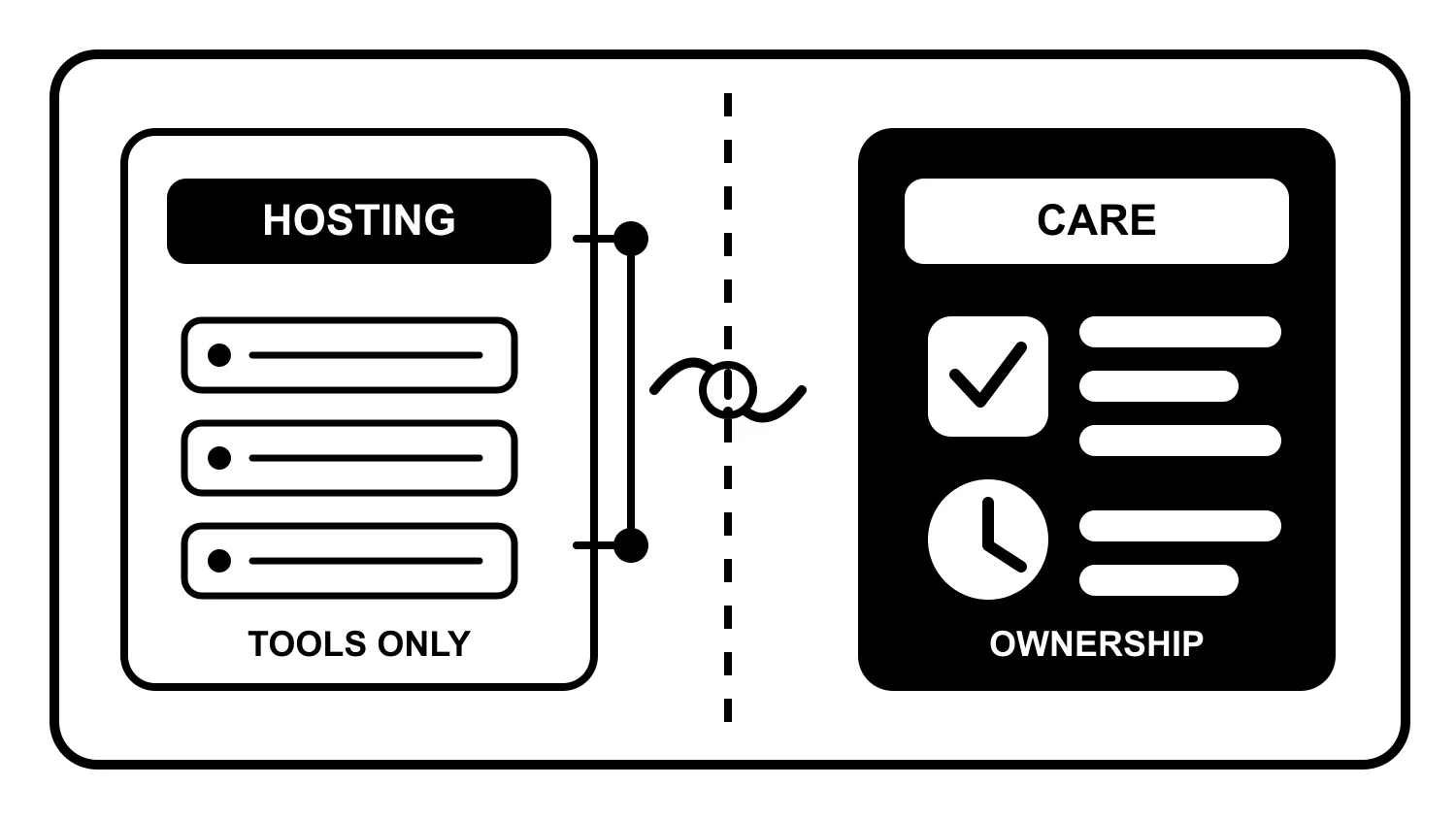
Cheap hosting and managed website care can look similar when nothing is wrong.
The homepage loads. The bill is low. The dashboard says the account is active. Everyone moves on.
The difference shows up during incidents.
A contact form stops sending leads. A plugin update breaks a layout. An SSL certificate chain misbehaves. A DNS record points to the wrong place. A server gets slow during business hours. A security alert names a plugin you forgot was installed. Suddenly the question is not “who hosts the site?” It is “who owns the problem?”
That is where the cheap option usually gets expensive.
Hosting is infrastructure. Care is ownership.
Hosting gives your website a place to live: server space, PHP or static file delivery, bandwidth, storage, SSL support, and a control panel.
That matters. Bad hosting can create real problems.
But a hosting account does not automatically watch your business outcome. It usually does not know whether your form delivered to the right inbox, whether your WordPress plugin stack has a known vulnerability, whether your sitemap is still clean, whether a cached page is hiding a broken layout, or whether a redirect change damaged a lead path.
Managed website care is different because it includes the operating work around the website.
For a small business, that means someone is responsible for the signals that affect leads, trust, security, and recovery. Not in theory. In practice.
Incidents rarely stay in one box
Website problems do not respect vendor categories.
A lead form issue may involve WordPress, SMTP, spam filtering, DNS, Google Workspace, a plugin update, and a hidden form field. A security alert may involve the plugin version, whether the plugin is active, whether a patch exists, whether attackers are exploiting it, and whether the site still works after the fix.
Even a “hosting” incident can spill over into decisions about cache, DNS, SSL, monitoring, backups, and customer communication.
Cloudflare’s February 2026 outage is a useful reminder. Cloudflare reported that a service outage affected customers using Bring Your Own IP after an internal automation withdrew roughly 1,100 BYOIP prefixes. The technical cause is not the point for a local service business owner. The business lesson is simpler: infrastructure providers can have incidents too. When they do, somebody has to know what changed, what is affected, and whether the site is actually reachable for customers.
Cheap hosting sells access to a platform. Managed care sells response.
The cheapest plan usually assumes you will manage the risk
Low-cost hosting works best when the website is simple, the business has low risk, and somebody technical is already paying attention.
That last part is the catch.
Most business owners do not want to spend Monday morning checking security advisories, cache headers, SSL status, backup retention, broken forms, plugin conflicts, DNS records, and Search Console noise. They want the website to help the business.
CISA’s small business cybersecurity guidance pushes owners to track patching, backups, MFA, incident response, and restore testing. The FTC’s small business cybersecurity guidance says to automate software updates, back up regularly, monitor for unauthorized access, and prepare incident response and recovery plans.
None of that is exotic. It is normal ownership.
The issue is that someone has to do it.
What managed care should include
A real website care plan should cover more than “we can log in if you need us.”
For most small business websites, the baseline should include:
- Uptime and SSL monitoring.
- WordPress core, plugin, theme, and PHP update oversight when the site runs WordPress.
- Security alert triage: affected or not, patched or not, urgent or routine.
- Off-server backups with enough retention to recover from mistakes that are not caught immediately.
- Restore confidence, not just backup existence.
- Form and lead-path checks.
- Cache, performance, and broken-page review.
- DNS, redirect, and hosting record awareness.
- Documentation of meaningful changes.
- A clear support path when something breaks.
The list is not glamorous. That is probably why it works.
Good care reduces drama because the basics are already being watched.
Cheap hosting is fine until you need judgment
There is nothing wrong with choosing a low-cost hosting plan for the right kind of site.
A hobby project, a low-stakes archive, or a simple static page may not need much. Paying for a heavier care plan there can be wasteful.
But if the website is tied to leads, appointments, payments, hiring, client intake, or local search visibility, the math changes.
The business is not buying disk space. It is buying continuity.
That continuity depends on judgment:
- Is this alert urgent?
- Is the site affected?
- Will this update break anything?
- Did the fix work?
- Is the backup usable?
- Are leads still coming through?
- Does the public site match what the dashboard claims?
A cheap hosting plan can give you tools. It usually will not make those calls for you.
What business owners should ask before choosing
If you are comparing hosting and website care, ask practical questions.
Who watches the site after launch? Who gets the alert when SSL fails or the site times out? Who checks whether the contact form still sends? Who reviews plugin security notices? Who backs up the site, where do those backups live, and has anyone restored one? Who documents changes? Who decides whether an issue is urgent, important, or noise?
If the answer is “the hosting company,” verify what that actually means. Many hosts keep servers running. That is not the same as managing your website as a business asset.
If the answer is “nobody,” the low monthly price is hiding work that will still need to happen.
Robben Media’s position
Robben Media does not sell hosting as a commodity.
We care about the website because the website is part of the revenue system. For WordPress sites, that means updates, monitoring, security triage, backups, uptime, SSL, forms, cache, and post-change checks. For static, Astro, and app-style sites, the stack changes, but the operating standard does not.
Someone has to own the boring parts before they become expensive parts.
That is the difference between cheap hosting and managed website care.
If your site matters to the business, buy the plan that includes judgment, response, and proof. A low bill is nice. A working lead path during an incident is better.
Robben Media can help with website hosting and maintenance, WordPress maintenance, and website security.
Sources
Jeremy Johnson
Owner
Jeremy co-owns Robben Media and directs strategy for every client engagement. With a Computer Engineering degree from Missouri S&T, he brings deep technical expertise in web development, SEO, and automation. Before acquiring Robben Media in 2023, Jeremy led marketing and branch management in the mortgage industry. He believes marketing should be measured by revenue generated, not impressions reported.